1

Experiences in Istanbul

IMG_3029 (Small)

Christian and I spent about four days in Istanbul. Enough time to hit the main sights and get a glimpse of some of the neighborhoods. But by no means enough to explore the nuances of this vast city where 11 million people are spread across 39 districts. Here are a few of our impressions and experiences.

  • What we learned on Istanbul’s history: Istanbul came to prominence when the Roman Emperor Constantine established it as one of the capitals of the Roman Empire under the name Constantinople in 330 AD. Since Constantine had converted to Christianity, Constantinople became one of the most important Christian cities, outside of Rome. Soon after, when the Roman Empire split in two (east and west), Constantinople became the capital of the Eastern Roman Empire, otherwise known as the Byzantine Empire. For the next several hundred years, Constantinople was the biggest metropolis of the Western Hemisphere. Islamic influence in the region increased and by 1453 the city became part of the Ottoman Empire. The Ottoman Empire was one of the greatest Islamic empires in history, spanning through until the early 1900’s. After the fall of the Ottoman Empire emerged the modern day Turkish Republic in 1923 and the capital was moved to Ankara. Initially the population of Istanbul was decimated in half but structural changes and the modernization of the city together with an influx of people looking for work steadily increased the population. Today Istanbul is a unique combination of old and modern, East and West, and Islam and Christianity (and other religions).
  • “Must sees” in Sultanahmet: The main sights (most of them are in the Sultanahmet district) are definitely worth a visit, even though they are very touristy.
      • The Hagia Sofia specifically reflects the influence of the Byzantine and Ottoman Empires. It’s an Orthodox Church, turned mosque, turned museum. So as you can imagine it is a pretty unique combination of Christian and Islamic architecture, art and symbols in one building.
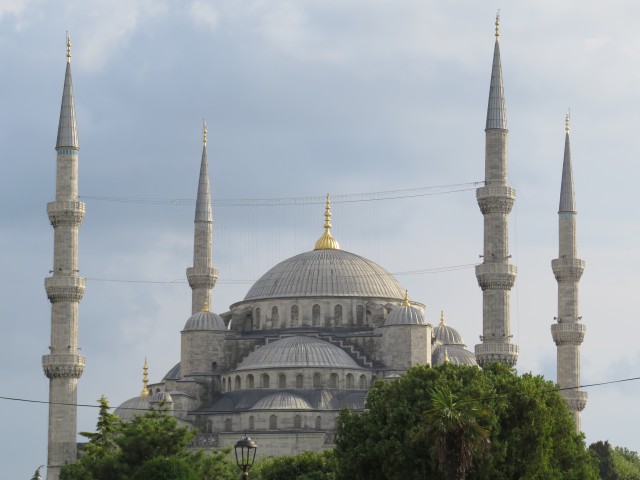
      • The Blue Mosque is also a grand building with beautiful interior tile work (most of it with blue tiles, hence the name). It is an active mosque, therefore only a small part is roped off for visitors to go through and admire the interior. I’ve read in a blog post that it’s worth visiting some of the other big mosques in town that are equally impressive in order to avoid the crowds.
      • The Topkapi Palace. Unfortunately we ran out of time to visit this grand palace that was the primary residence of Ottoman Sultans. But I had the chance to visit it a few years ago. Back then I was impressed by the imperial harem (i.e., the Sultans private apartments with more than 400 rooms).
      • The Grand Bazaar and Spice Bazaar: You can truly get lost in the Grand Bazaar. It’s one of the largest and oldest covered markets in the world with 61 streets! Lots of good souvenirs to buy there. But be ready to bargain. It’s part of the game. We took our time to stroll through and explore and after getting lost (as expected) we found ourselves in the book bazaar. That said, we behaved and didn’t buy anything as our carry-on only luggage is already close to its limits :). Also worth making a stop at the spice bazaar with its incredible number of spices, sweets and many other goodies.
      • Get lost walking around town: Satisfied to have seen the main attractions, Christian and I spent most of our time exploring the different neighborhoods. Our guesthouse (Hotel Nomade) was located in the main tourist area Sultanahmet. While incredibly convenient (and a nice place to stay at, especially with its amazing rooftop terrace and direct view on the Blue Mosque) we would probably pick a different neighborhood next time. We loved to walk around Karakoy or Galata (the broader Beyoglu district), getting lost amidst the cobble stone streets and observing what locals were up to. Istanbul is a city of contrasts. You walk down a street that seems to fall apart, then turn around a corner to find an art gallery next to a hip coffee shop where locals hang out. Taking the ferry over from the European to the Asian side was a great call as well. Not only did we get great views onto the Topkapi Palace but we mingled with locals on their daily commute. Over on the Asian side we explored Kadikoy, more of a student-like, alternative area with lots of bars and cafes, where locals were enjoying their Sunday afternoon teas or beers. A small but true taste of the local culture!
      • Enjoy the Rooftops: Istanbul has amazing rooftop restaurants and bars. Once you are up there you have a totally different impression of the city. Some of the hipper restaurants are hidden, so worth doing some research beforehand to find them. We enjoyed a romantic dinner at Leb-i-Derya. Modern Turkish food with incredible sunset views!
      • Cats are everywhere: You can’t spend a day in Istanbul without noticing cats. They are everywhere. On the roof deck of our B&B. In train stations. In every single neighborhood you’ll go to. Even in some restaurants. I must say I’m more of a dog person. Therefore, I was very surprised not only about the sheer number of cats “living” in this city (these cats are not owned by a single person but rather roam around freely) but also that the Turkish people love to pet and feed them. Most cats looked well taken care of and didn’t really bother anyone. And the more days we spent in Istanbul, the more the cats seemed to be an integral part of the city.
      • Eating traditional Turkish food at Ciya Sofrasi: We ate well in Turkey but this place stood out. Thank you to my friend Matthew Rascoff for the recommendation! The owner’s, Musa Dagdeviren’s, vision is to preserve traditional Turkish recipes. There are actually three restaurants in the same street. Two of them offer kebab, grilled meats and fish. The other one “Ciya Sofrasi” prepares what was typically the “home cooked” food with an incredible spread of mezzes (spreads and other appetizers), lentil and yogurt soups, meat balls in cherry sauce, lamb sausages, eggplant stews and many other tasty dishes. Here is a link to a 2010 New Yorker article that gives you the whole story!
      • Cooking traditional Turkish food at “Cooking Alaturka: Christian and I love new experiences. Plus, we both love good food and cooking. So what would be a better birthday present for Christian than to do a cooking class in Istanbul? Making our way through a thunderstorm and pouring rain we arrived at Cooking Alaturka, Istanbul’s first cooking school. We spent the first three hours in the kitchen cutting, stirring, sweating and laughing with Feyzi, the chef, and Mara, the host and sous-chef. Preparing Turkish food is really labor intensive, especially all the cutting of vegetables that need to go into the soup, spreads and sauces! Our work paid off. We had prepared a 5-course meal: Red lentil and bulgur soup, green runner beans cooked in an olive oil base, zucchini patties with herbs and cheese, lamb stew in tomato sauce and smoky eggplant puree, and walnut-stuffed figs in syrup. Not only did we get to enjoy these great dishes, but what we cooked was also served to the other guests at the restaurant that evening! What a great way to end our Turkey experience. Highly recommended!


3

Sardinia – Our Honeymoon

IMG_2754 (Small)

Christian and I spent one week in Sardinia. Our honeymoon. It was magical! Well, one could say every honeymoon is probably magical but Sardinia surprised us from many different sides. Sardinia has a unique and beautiful landscape that offers a lot to explore and many culinary delicacies influenced by various cultures over the last centuries.

From Vienna we flew into Olbia in the North of Sardinia, picked up our rental car and made our way straight from the airport to our first dinner. Well, actually, it wasn’t quite as straight forward as that. Let me explain. On the flight over, Christian and I made a pact that during our honeymoon we would attempt to be almost entirely offline. No answering emails. No checking Facebook. Turns out that Sardinia made this rather easy since internet across the island was generally somewhere between spotty to non-existent. Anyway, this situation made our rental car pickup more “adventurous” than we would have liked. Because I hadn’t really prepared for being offline (and because there isn’t free internet access at Olbia airport) we realized we didn’t know who we were actually renting the car from! I won’t bore you with details but we finally worked it out, so about 45 minutes behind schedule we finally left Olbia airport on our way to our first dinner in Sardinia.

As on most of our travels, picking the right restaurants (and sometimes even planning whole trips around food) was a top priority for the two of us. Christian had already researched and booked some great restaurants (leaving some nights for exploration as we love unplanned adventures as well). But back to Olbia and the little restaurant called Dolceacqua. This is where we were introduced to our first Sardinian pasta. And yes, we did eat a lot of pasta on our trip – we are in Italy after all! But we discovered new varieties like the “Culurgiones”, a type of ravioli filled with ricotta cheese and herbs (it can also come with a potato and mint filling). It reminded me a lot about the “Kaerntner Nudeln” (Corinthian dumplings) that my grandmother in Southern Austria used to make. Then there is a small round shaped semolina pasta called “Sa Fregula” which tastes almost couscous like, gratitude to the middle Eastern and north African influence of Sardinia over the centuries. As wine lovers we wanted to pair our meal with some red wine, gravitating to Northern Italian grapes given our closer familiarity with that region. The waiter gave us a surprising look – why don’t you order a Sardinian wine? So we went with his recommendation of a regional wine. It tasted great!

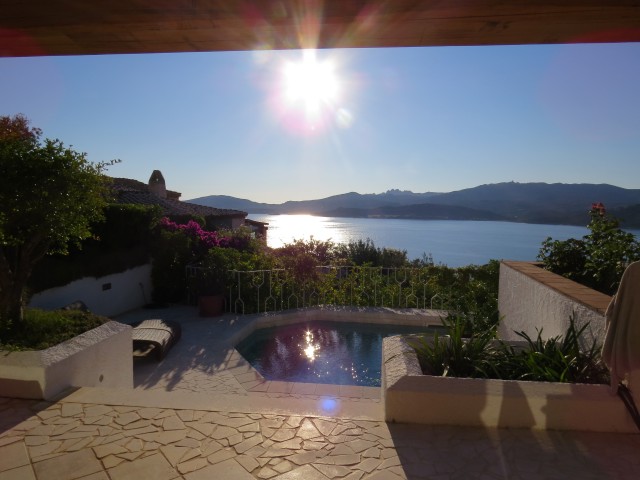
Happy about our first Sardinian meal, our next highlight awaited us: our accommodation for the first three nights: the Villa del Golfo Relais & Spa in Cannigione. If you ever need a place for a honeymoon, book the Luxury Suite with sea view and private pool. It was heaven! Christian described it as easily the best hotel he’s ever stayed at. Not only were we welcomed with sparkling wine and fresh fruit in our room (which we immediately enjoyed next to our private pool!) but also two hearts made out of flower pedals on our bed (which I always dreamed of when I was little).

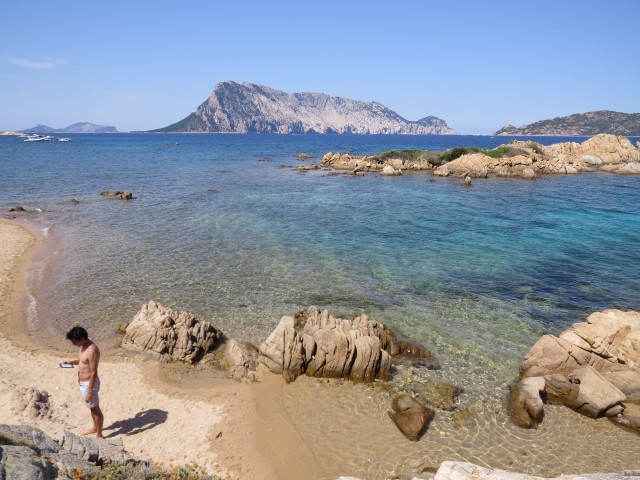
We woke up to stunning scenery, the sunrise over the Costa Smeralda. The region is well known for the beautiful La Maddalena archipelago. The archipelago is a collection of islands that showcases the beauty of Sardinia with its rough sandstone-like landscape and its diverse vegetation in various shades of green (think olive trees meet cactus plants meet eucalyptus and palm trees), rising against the blue turquoise sea and stunning sand beaches.

IMG_2638 (Small)

The first activity on our list: rent a Vespa! I felt like a real Italian. Although it was probably pretty obvious that we weren’t, driving at half the speed of locals (and sticking to road rules which true locals don’t really do) and stuttering along while getting used to the gears. But we made our way safely to our destination: Porto Cervo, also sometimes called the “Cote d’Azur of Sardinia”. It’s a beautiful little seaside village with an upscale feel. We did see various yachts but unfortunately no celebrity sightings.

For dinner that day we chose to try something traditional Sardinian, an Agriturismo called La Colti outside of Cannigione.  An agriturismo is an active farm that serves a pre-set dinner with farm-raised and produced food and local wine. Most agriturismos also rent out a few rooms (which looked like a special place to stay and will be on our list for future travel plans!). The one dish that is a must try in Sardinia is “Su Porcheddu”, roasted suckling pig. The dinner was delicious. The suckling pig was cooked according to its original preparation method on a spit over an open fire (the perfect crackling!) and served on a bed of myrtle leaves on a cork plate. Myrtle is one of the national herbs here. It appears in the Sardinian cuisine as spice, in sauces, and desserts all the way to the myrtle liquor (which tastes a bit like the French Chartreuse). After the four set courses including antipasti, soup, pasta, suckling pig and dessert, we made our way home, happy and very, very full.

The next day might have been our favorite one of the whole Sardinia experience. A full-day boat trip around the La Maddalena Archipelago. No cloud in the sky and a nice breeze to cool us down, we steered our boat around the archipelago, exploring small beaches and bays. We felt a real sense of freedom. Following the recommendation of the boat rental guy we navigated our little boat to his favorite beach on the Isla Spargi. A great decision. It was simply beautiful with a small sand beach and spectacular turquoise water!


We anchored our boat a little way out from the shore so as to not damage the propellers on the rocks and then swam our picnic over to the beach (funnily enough, despite our best efforts we still managed somehow to ding the propellers and had to pay a small fee to cover it). Swimming over with our belongings was a good workout before enjoying our picnic of prosciutto, cheese, tomatoes, grapes, and the traditional pane sardo or pane carasau (a paper-thin, crisp Sardinian flatbread that is served everywhere) and some white wine.

Back home at 7pm we quickly freshened up with a quick dip in our pool and headed out for dinner to La Gritta in Palau, a place that I’d highly recommend for its stunning views and sunsets over the Archipelago. Again we were pointed to a local Sardinian wine, this time called Rosso Rubio, and might have found a new favorite red. Sardinian wines, we are convinced! New culinary discoveries that night included wild-boar ragout pasta, local lamb and more cheese variations. Cheese seems to find its way into all meals of the day, including the “Seadas” that we tried for dessert. It’s a deep-fried filo pastry filled with pecorino cheese made of sheep’s milk and served with honey. Talking about sheep, did you know that Sardinia has the highest density of sheep in the world? It apparently ranks before the UK and New Zealand!

After three days in the archipelago we drove to the mid-Eastern part of Sardinia, the Nuoro region at the Golfo di Orosei. This area with its high mountain ranges and small canyons and rivers provides an interesting contrast to the somewhat flatter northern and southern parts of the island. We stayed at Hotel Su Gologne close to Dorgali which turned out to be an Alice in Wonderland- type experience, as every hour we spent there we discovered new and wonderful things. The place started out as a restaurant about 40 years ago. Bit by bit, the owners added individual rooms across the property. Therefore, each one of today’s 70 rooms has its unique layout, furniture and decoration. On the topic of the uniqueness of the rooms, we were actually a little disappointed with the first room we were shown. The view was looking into the parking lot and the overall room was quite dark. So I gathered up the courage to ask if they had another room with a better view. I’m glad I did. The next room we got was just fantastic.

Sardinian artists play a major role in Su Gologne’s identity. You can find Sardinian paintings, ceramics, sculptures and woven carpets from famous local artists throughout the property (plus there are lots of hidden terraces and rooftops to relax as we discovered during our stay). It’s like living in an active workshop and museum at the same time. One of our favorite meals there was an artisanal dinner. Two local women were baking fresh focaccia bread with different cheese, meat and vegetable toppings. Very tasty and the whole experience was special.

As for the area itself, Cala Gonone is the main highlight. It’s a small beach town where steep mountain walls meet the blue water of the Golfo. Unfortunately it was a bit windy and overcast the day we visited so we decided against another boat trip (although we would have been excited about exploring the caves only accessible via the ocean). Instead we opted for a kayaking trip along Lago del Centrino all the way to the Sorgente su Cologone (the source of the river and lake), a good 3-hour roundtrip.

After another three nights in Su Gologne we ended our journey with some sightseeing in the capital city of Cagliari. One the way down south we made a brief stop near Oristano to see the little beach town San Giovanni di Sinis at the Golfo di Oristano on the West coast. A very different feel than what we had seen in the other parts of Sardinia – flatter land, less vegetation and a rougher sea (almost like the Atlantic Coast in the South of France).

Once in Cagliari, we checked into our small B&B “The Place Cagliari”, tucked away in one of those typical narrow Italian streets in the middle of town. We used the remainder of the afternoon to see the main sights in the city, mainly the old part of town, the Castello neighborhood, and the surrounding districts. A very charming city.

As a final culinary highlight of our honeymoon we treated ourselves to a 7-course dinner with a wine pairing at Dal Corsaro. Sardinian traditional food meets culinary modern art. A nice touch were the plates, each course came on a unique plate – ranging from cork and ceramic to sandstone-type plates. What a wonderful way to end our journey in Sardinia!

But who could leave Sardinia without one last dip in the blue sea. The next morning we hit the beach at Cala Mosca (right next to Cagliari’s main beach of Poetto). Ready to continue the journey! And off we are to Lisbon where we are meeting our friends to catch a flight to Tomorrowland in Belgium, one of the biggest EDM festivals! Stay tuned for more adventures from Schnitzel and Vegemite!