
0

Meeting the Famous Dr. Ho

IMG_5457

We had first learned about Dr. Ho from our Lonely Planet. Apparently he was a “world famous” Taoist doctor and herbalist, who was said to have cured illnesses from patients around the world. Curious to learn more and somewhat skeptical if this was one of those tourist attractions, we set out to find Dr. Ho in Baisha, a small town about 10km from Lijiang in the Yunnan province in Southwest China.

Upon finding Dr. Ho’s ‘clinic’ we were hit by a wall of Chinese and international newspaper articles. The articles were framed in glass and plastered all over the outside wall of the house. Somewhat more convinced that there might be something to this story we ventured into the building.

We found ourselves in a dark room with glass cabinets and sales counters that were covered in yet more newspaper clippings. Most of them were faded and yellowish but still readable. A middle-aged man called Ho Shu-Long, who introduced himself as Dr. Ho’s son, greeted us immediately and gestured us to sit down on a wooden bench. His English was fairly good and he could even speak a few words of German. His father had learned some German from Joseph Rock, an Austrian-born botanist who spent about 30 years in the Naxi region to study plants and herbs. Barely having sat down, Ho Shu-Long brought us yet more newspaper articles, in both English and German, neatly arranged in plastic covers.

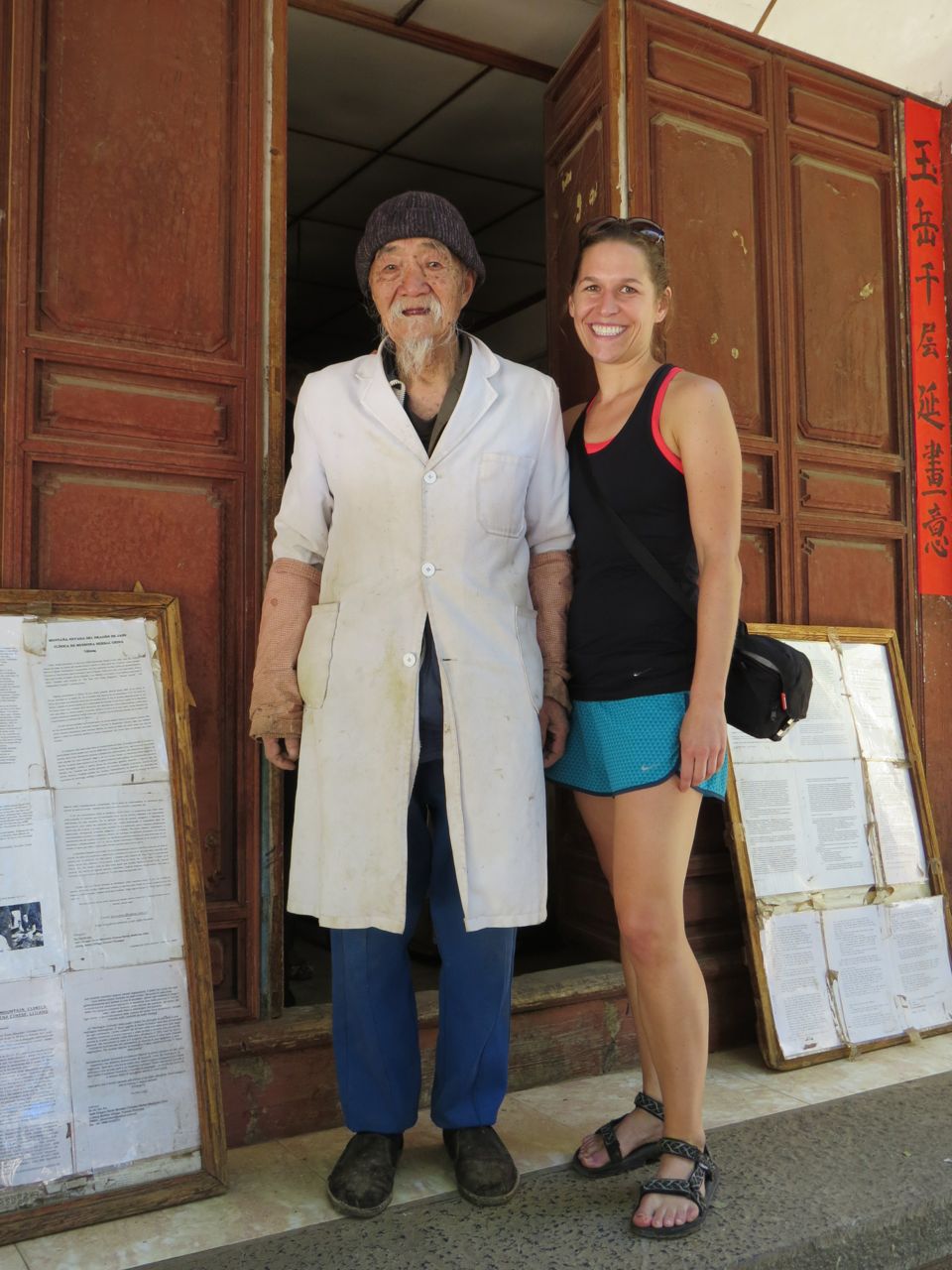
An old woman, that has been sweeping the outside area of the house when we arrived, slowly walked into the room. We were told that this was Dr. Ho’s wife, who was a respectable 91 years of age. She seemed unfazed by our presence, going about her daily business. We asked if we could meet Ho Shu-Long’s father but he said that wasn’t possible. I felt disappointed. Having found the clinic I had gotten curious to learn more. Two minutes later however an old men slowly walked in from the backdoor. It was Dr. Ho! He looked exactly like one would imagine a wise old Chinese man with his white wispy beard, a grey, head-hugging hat, and a white somewhat dirty doctor’s coat. He moved around with slow but intentional movements. For his 92 years he looked in great shape! We introduced ourselves and he seemed excited that I’m Austrian, probably evoking old memories from his friendship with Joseph Rock. Similarly, he was excited about Christian’s Australian origins as his doings had been covered by Australian TV and radio shows as well. He pointed us to books by Bruce Chatwin, an English travel writer. It was Chatwin’s 1986 New York Times article “In the little-known Kingdom of Joseph Rock” that shot Dr. Ho to fame. Many journalists and camera crews followed thereafter.

Dr. Ho investigated if we had any problems after he had positively remarked that we seemed to be in good shape (many of his patients seem to have weight problems). Well, that was a good start! Christian told him about his high cholesterol levels. That’s where it got interesting. The two set down at the corner of one of the sales counters. The consultation started. It was surprisingly short. Dr. Ho basically just asked Christian a few simple questions before taking off into the adjacent room. The room was overflowing with plastic jars and containers of all sizes. He took a brownish looking powdery mix out of a couple of containers and went outside to the back terrace where he mixed the dusty combination together. Back in the consultation room the instructions followed: drink the powder three times a day (for one month) mixed with hot water and some honey. Seems almost too easy. I was somewhat skeptical that this tea blend would mysteriously lower Christian’s cholesterol levels. But I was too quick to judge.

Dr. Ho gave us another flyer (this one in German) laying out his holistic philosophy for a happy and healthy life. While his medicine will help, he tells his patients that “Optimism is the best medicine” and urges them to: “Live a simple life. Eat simple. Don’t smoke or drink.” He also advocates that both Western and Chinese medicine in the right combination can have a very positive impact. That seemed very open-minded. His son elaborated on their philosophy: “Live with compassion as for a loving heart will be happy. Live your life in balance. It’s good to experience all emotions but not to the extreme”.

He continued: “My mother (remember she is 91) is completely self-sufficient. To this date she washes her own clothes, prepares and cooks food and cleans the house.” Truly stunning! “While some people would call me a bad son, my philosophy is that those chores give my mother’s life meaning and make her more happy.” He believes that for the same reasons his 92-year old father still runs the clinic

Besides getting Christian’s cholesterol-curing tea (we’ll report back on its effectiveness), this turned out to be a very inspirational visit. Good food for thought on what really matters to live a happy life.
IMG_5494

2

Snapshots of China

IMG_5712

Beijing

Having been to Beijing before during the frenetic times of the Beijing 2008 Olympics, I was curious to return to see what the city looked like when it was “business as usual.” Somewhat surprisingly, it almost felt like the city was even more frenetic this time round. Traffic was heavier. Air pollution was thicker (smog prevented us from seeing the sun during the 4 days we were there). And it even felt like security checks were more intense (for example, you now go through security checks for the metro and many popular public monuments). But after spending 3-weeks in almost isolation in Mongolia, Christine and I were ready to take on a big city.

We hit the key tourist sites like Tiananmen Square and the Forbidden City. We also did a tour of Peking University after I presented to the MBA class there on careers post business school and why they should be using LinkedIn (yep, months after leaving my job at LinkedIn I’m still cheerleading for them. Go LinkedIn.). And we searched around for the best food Beijing has to offer from Peking Duck to Cantonese specialties (stuff I grew up with) to Hot Pot.

Great Wall of China

Visiting the Great Wall was just breathtaking, even second time around. When I did it the first time back in 2008, we went to the more “popular” (read: touristy) section of Badaling. Luckily, this time my wonderful friend and China expert, Nat Gray, encouraged us to go to the more secluded section of Jinshanling. We followed her advice and are so grateful we did.

We visited on a Sunday morning. There was kind of an eery feeling we arrived, in part due to the dense mist in the air, but mainly due to the fact that there was no one else around. Here we were, visiting one of the world’s most popular tourist attractions on a weekend and we were the only people in sight! It took us almost an hour before we saw other people on the Wall, and even then, we probably only saw about 20 or so other people during the four hours we traveled along the Wall. It was an incredible experience.

While driving to and from the Great Wall we did a bit of reading up on the history. Many of us know it was built to help defend China from its aggressive neighbours like the Mongols. What we didn’t previously know is that sections of the Wall were originally built even before China was a unified kingdom by the separate independent states. It wasn’t until the Qin dynasty (221-207 BC) when China was unified as a single kingdom did the project begin to make it a Wall for a unified China, and hence the moniker the “Great” Wall. Interesting, no?

Xi’an and the Terracotta Warriors

We put a 2-day stop in Xi’an on our itinerary largely to see the Terracotta Warriors. We were pleasantly surprised that Xi’an is a wonderful city in its own right. It also has a rich history, being the original capital of the unified China up until the Tang dynasty ended around 907. Some of the top things to do in Xi’an are to visit the old town (particularly the Muslim Quarter where you get to taste some incredible street food) as well as marvel (or better still, bike ride around) the 14km city wall.

Nonetheless, seeing the Terracotta Warriors was the highlight of our trip to Xi’an. The quick history on the Terracotta Warriors is that they were built by the first emperor of the unified China, Qin Shi Huang back around 210 BC. The purpose was for the army to ensure he would be as powerful in his afterlife as he was during his time in the real world. It is said he kicked off the project when he was 13 years old, and had 600,000 people work on it until his death at age 50. But the project was never officially documented so it wasn’t until some peasant farmers in 1976 accidentally stumbled upon it when trying to get water from a well that the incredible work was discovered.

The museum is incredibly well done. It is built on the actual site that the Terracotta Warriors were found and excavated, leaving each of the pieces in their original places. Being there makes you feel like you are part of an archaeological excavation. But what blew me away was that while there are tens of thousands of these life-size warriors, each of their faces is distinct. Incredible.

Jiuzhaigou and Huanglong

One of China’s not-so-secret natural treasures is Jiuzhaigou National Park. I say “not-so-secret” because even though most people outside of China have probably never heard of this park, most people in China do know about it. And when we visited, it felt like EVERYONE in China was there visiting with us. While admittedly the crowds did detract somewhat from the experience, the park itself was nothing short of breathtaking. I truly have never seen lakes with such vibrant colours before. If I didn’t know better, I would have said they looked artificial because they were that spectacular. The blues, greens, turquoises, milky whites of them were really incredible. My words, and even our photos, don’t do it justice.

Huanglong is a couple of hours drive away from Jiuzhaigou. Although it’s a fair bit smaller, it is no less breathtaking and fortunately doesn’t attract the same drones of people as Jiuzhaigou. It ended up making for an even better experience.

We spent a full day at each of the parks. A full day was enough for Huanglong but you could probably do 2-days at Jiuzhaigou if you had the time.

Shanghai

Shanghai was the highlight of our time in mainland China. Partly because it is a great city. But mostly because we spent the time there with one of my closest friends, Nat Gray. As her wedding present to us, Nat organised our whole Shanghai itinerary and shouted us for everything. It was incredibly generous of her (thank you again, Nat!). First night we went out for a dinner with her and her friends at a great Sichuan restaurant followed by drinks and karaoke into the wee hours of the morning (we only could manage to stay out to 3am after getting up earlier that day at 5:30am to make our flight, but we heard others in the group sang until 5am!). Next day we were all a bit hazy but still managed to pull ourselves out of bed to have dim sum with Christine’s HBS sectionmate, Sandra Weng, and her beautiful daughter, Serena.

During our 4-nights in Shanghai, Nat organised a wonderful itinerary walking through the best parts of town; drinking with the best views of Shanghai’s famous “Bund”; and eating at incredible restaurants including a food walking tour (if you’re interested, we highly recommend “Untour” and their food tour of Shanghai). Nat also bought us tickets to take the high speed train to Nanjing (1hr 15 mins from Shanghai) so we could see the Memorial Museum to the Nanjing Massacre. Was very interesting to learn about the atrocities committed by the Japanese in China during World War II. A very moving experience.

After four incredible days in Shanghai with Nat, we got a good appreciation for life in Shanghai and felt sad to leave.

Lijiang, Shuhe and Shaxi

Lijiang was the last stop of our travels around mainland China. Again, it was a recommendation of Nat Gray (and her friend, Amanda). Funnily enough, we had several people we randomly met in China during our travels who also all recommended (unprompted) that we check out Lijiang. The charm of the place is the old town, with its old style buildings and cobble stone streets that really takes you back in time.

We had been warned that Lijiang Old Town can be a little overrun by tourists, and while it was busy, we didn’t think it was all that crowded compared to what we’d seen earlier on our trip in places like Beijing, Shanghai and Jiuzhaigou. Our accommodation was at a wonderful boutique hotel, The Bivou, which was in another old town called Shuhe, 4km from Lijiang Old Town. One of the charms of staying in Shuhe was that it was smaller and less crowded that Lijiang, while having all the same charm.

During our stay we rented bikes and rode around to other old towns in the area, including Baisha and Yuhu. The highlight of our excursion was meeting a famous doctor and herbalist, Dr Ho. Christine is going to write about this in a separate post soon.

On another day we hired a driver to take us to Shaxi (about a 2hr drive away). We had heard about the famous Friday markets in Shaxi, which have been happening since the days of trading along the Tea-Horse Road (similar to the Silk Road). It was a very special experience, and once again Christine will write a separate post on it.

There are actually so many other activities we could have done in the surrounding areas of Lijiang if we had more time. It’s funny, that even though we’re traveling the world for a year that we still sometimes feel rushed for time. But there’s just so many things to do and places to see!

Hong Kong

We had not initially planned a stop in Hong Kong. However when we found out that one Christine’s closest friends (who also acted as one of our marriage celebrants), Shilpa, had relocated there, we made sure it was a stop on our journey.

It was so nice to reconnect with Shilpa. Although I was out of action for a couple of days (recovering from a cold I caught on our last day in Lijiang), the girls explored the city together, bringing their hula hoops along for good measure. We also got to catch up with Greg, an Australian gut we met in Cappadocia, for dinner. He recently moved there with his fiancee to teach English at a local school. We learned from Greg that Hong Kong has a number of fantastic hiking trails and beaches, which he had just started exploring. They sound pretty amazing. We didn’t get around to doing any on this trip (my illness and a typhoon warning kept us mainly indoors) but now are keen to return to Hong Kong to check them out.